Happy Puzzle: Where Learning Meets Playful Typography
Imagine a classroom where spelling practice feels like playtime. Where sight-word flashcards don’t just teach—they delight. Where a student’s first handwritten sentence isn’t just legible, but alive with color, shape, and personality. That’s the world Happy Puzzle invites educators, designers, and parents to build—one vibrant letter at a time.
More Than Just a Font—It’s a Learning Tool With Personality
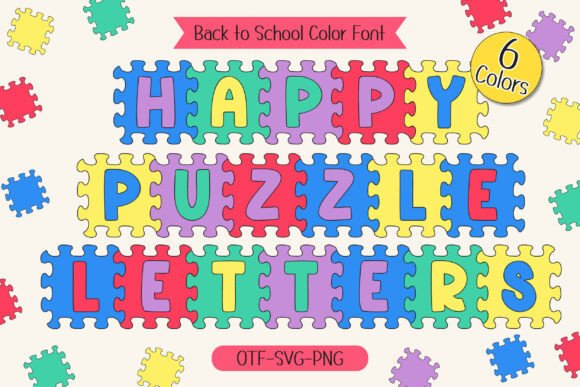
Happy Puzzle isn’t modeled after sleek corporate logos or minimalist design systems. It’s inspired by something far more tactile and timeless: classic foam alphabet tiles—the kind that stick to whiteboards, nestle in tiny hands, and survive snack-time spills. Each uppercase and lowercase letter is carefully crafted to echo those familiar, chunky, rounded forms—but translated into a fully functional, digital typeface family.
What sets Happy Puzzle apart isn’t just its nostalgic charm—it’s its intentional design language. Rounded corners soften sharp edges. Generous counters (the open spaces inside letters like ‘o’ or ‘e’) improve readability for emerging readers. Letter heights are consistent yet friendly—not rigidly uniform, but gently harmonized to support visual scanning and letter recognition. And yes—the colors? They’re not decorative afterthoughts. They’re built-in, purposeful, and joyful.
Six Colors. One Cohesive System.
Happy Puzzle includes six distinct color fonts, each delivering the full Latin character set—including numbers, punctuation, and common accented characters. You’ll find:
- Happy Puzzle Red — bold and attention-grabbing, ideal for headings and high-impact labels
- Happy Puzzle Blue — calm and trustworthy, perfect for instructions and reading passages
- Happy Puzzle Green — fresh and growth-oriented, great for checklists and positive reinforcement
- Happy Puzzle Yellow — warm and energetic, excellent for callouts and interactive elements
- Happy Puzzle Purple — creative and imaginative, well-suited for storytelling and art-related text
- Happy Puzzle Orange — enthusiastic and inviting, ideal for welcome signs and activity titles
No need to manually recolor letters or layer effects. With Happy Puzzle, color is baked in—and consistent across platforms. Type “ABC” in Happy Puzzle Blue, and every letter renders in that exact shade, with proper spacing and alignment. That reliability matters—especially when you’re designing printable worksheets or prepping files for school printers.
Real Classrooms, Real Uses
Teachers don’t have time for fonts that look great on a mockup but break down during actual use. Happy Puzzle was designed with daily classroom realities in mind:
- Printables that pop: Whether it’s a phonics chart, a sight-word bingo card, or a behavior tracker, Happy Puzzle adds instant visual hierarchy without extra design steps.
- Digital learning materials: Works seamlessly in Google Slides, PowerPoint, Canva, and most LMS platforms (when embedded or exported as PDF/PNG). Students see consistent, accessible color cues—even on tablets.
- Classroom décor with intention: Bulletin board letters, door signs, and hallway displays gain warmth and cohesion. No more mismatched clipart fonts—just one system that ties everything together.
- Student-facing creation tools: When kids design their own storybook covers or science posters using simple drag-and-drop tools, Happy Puzzle gives them professional-looking results—without needing design skills.
One second-grade teacher in Austin shared how she uses Happy Puzzle Red and Blue side-by-side on her weekly “Word of the Week” poster: red for the target word, blue for the definition and example sentence. “My students recognize the pattern now,” she said. “They know red means *stop and notice*, blue means *read and understand*. It’s subtle—but it sticks.”
Beyond the Classroom: Creative Flexibility
While Happy Puzzle shines in education, its versatility extends further—into spaces where clarity meets creativity:
- Kids’ apparel: T-shirt designs featuring playful phrases (“I ❤️ Reading”, “Future Scientist”) gain instant appeal with Happy Puzzle’s cheerful shapes and saturated hues. The font scales beautifully from chest prints to oversized back graphics.
- Children’s merchandise: Stickers, tote bags, lunchboxes, and party supplies benefit from Happy Puzzle’s high legibility at small sizes—and its ability to hold up under screen printing or vinyl cutting.
- DIY crafts & home learning: Parents building literacy kits, homeschoolers designing custom flashcards, or grandparents making personalized storybooks all report how Happy Puzzle reduces prep time while increasing engagement.
- Educational apps & websites: Designers integrating Happy Puzzle into UI elements—like progress buttons, achievement badges, or interactive letter tiles—find it bridges the gap between function and fun, especially for ages 4–9.
Practical Considerations Before You Use Happy Puzzle
Like any specialized tool, Happy Puzzle works best when matched to the right job. Here’s what thoughtful users keep in mind:
- Use it for impact—not immersion. Happy Puzzle excels in short bursts: titles, labels, highlights, and visual anchors. For long-form reading (novels, research reports), pair it with a clean, highly legible sans-serif body font.
- Check contrast for accessibility. While the colors are vibrant, always verify text-to-background contrast ratios—especially for students with visual processing differences. Happy Puzzle’s generous letterforms help, but background choice matters.
- Test print fidelity. Some school printers may slightly mute bright colors or compress fine details. A quick test page ensures your “Happy Puzzle Yellow” stays sunny—not pale.
- Licensing is educator-friendly. Happy Puzzle offers clear, scalable licensing options—including classroom-wide and school-site packages—so teachers and districts can adopt it without legal guesswork.
Why Teachers and Designers Keep Coming Back to Happy Puzzle
It’s not just about aesthetics. Happy Puzzle answers a quiet but persistent need: to make foundational learning feel human.
In an age of standardized assessments and ever-shifting edtech tools, something as simple as a well-designed, colorful font reminds us that literacy begins with curiosity—and curiosity thrives in environments that feel safe, joyful, and visually inviting. Happy Puzzle doesn’t replace pedagogy. It supports it—with warmth, consistency, and just the right amount of whimsy.
And for designers? It’s refreshingly straightforward. No complex OpenType features to configure. No manual kerning adjustments needed for basic use. Just install, select, type—and watch learning materials transform from functional to memorable.
Getting Started Is Simple
You don’t need a design degree or a budget for premium software. Happy Puzzle works in everyday tools: Microsoft Word, Google Docs (via downloadable .ttf files), Adobe Creative Cloud, Cricut Design Space, Silhouette Studio, and more. Many users begin with just one color—say, Happy Puzzle Blue for handouts—then gradually add others as projects evolve.
Try this: Open your next worksheet template. Swap the default heading font for Happy Puzzle Red. Add a subheading in Happy Puzzle Green. Watch how even small changes shift the tone—from “assignment” to “invitation.”
That’s the quiet power of Happy Puzzle—not shouting for attention, but extending a cheerful, confident hand toward every learner who sees it.