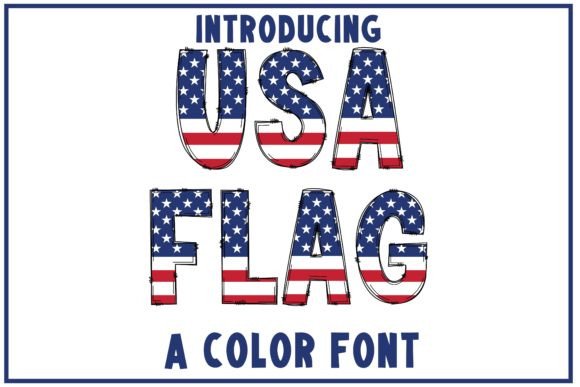
Usa Flag: A Patriotic Color Font
If you’ve ever tried to design something that feels authentically American—without leaning on clichés or overused clipart—you know how hard it is to strike the right balance between spirited and sincere. That’s where Usa Flag stands out. It’s not just another patriotic font. It’s a thoughtfully crafted, color-integrated typeface built around the red, white, and blue of the U.S. flag—but with personality, proportion, and practicality baked in.
Unlike standard outline fonts that require manual coloring or layering, Usa Flag renders each character with embedded flag colors, meaning the stripes and stars appear *within* the letterforms themselves. The “A” might feature a bold white star centered in a red-and-blue striped field; the “U” could wrap around vertical stripes like a banner. These aren’t gimmicks—they’re intentional, scalable, and legible even at small sizes.
Why Designers Reach for Usa Flag First
It’s rare to find a display font that works equally well on a 2-inch sticker and a 24-inch event banner—and still reads clearly. Usa Flag does exactly that. Its characters are generously spaced, with strong visual contrast and consistent stroke weight. That means no awkward gaps, no blurry edges when scaled down, and no need for extra shadow or outline effects to boost visibility.
The playful nature comes from subtle details: slightly rounded terminals, asymmetric star placements, and letters that feel hand-drawn—not sloppy, but confident and human. You’ll notice how the “S” curves like a ribbon, or how the “Y” splits into two clean stripes. These aren’t distractions—they reinforce theme and tone without sacrificing function.
Where Usa Flag Fits Naturally (and Where It Doesn’t)
This font shines in contexts where identity, occasion, and emotion matter more than neutrality. Think Independence Day cookouts, local parade flyers, school history projects, veteran appreciation campaigns, or small-batch merchandise for a family-owned shop in Asheville or Austin.
- Stickers & Decals: Its built-in color eliminates the need for multi-layer printing—ideal for vinyl cutters and print-on-demand platforms.
- T-shirts & Apparel: Works cleanly with screen-printing and DTG workflows. No registration issues—colors live inside the glyph.
- Digital Invitations: Renders crisply across email clients and social media previews, especially when paired with a clean sans-serif for body text.
- Educational Materials: Teachers use Usa Flag for bulletin board headers, timeline labels, or student project titles—adding thematic energy without overwhelming young readers.
- Local Business Signage: A coffee shop launching a “Freedom Blend” special or a hardware store running a July 4th sale can use it for window clings or sidewalk chalk stencils—immediately signaling tone and timing.
That said, Usa Flag isn’t meant for long-form reading, legal disclaimers, or data-heavy dashboards. It’s a display font—best used for headlines, callouts, logos, and short phrases where impact matters more than density.
Real-World Use Cases That Worked
A freelance graphic designer in Portland used Usa Flag to redesign the annual “Patriots’ Picnic” flyer for a historic neighborhood association. Previous years relied on stock flag vectors behind generic bold fonts—resulting in visual clutter and low engagement. This time, they set the event title in Usa Flag, kept body copy in Open Sans, and added minimal iconography. Attendance rose 22% year-over-year—and neighbors specifically mentioned how “the poster felt warm, not loud.”
Another example: a homeschool co-op in Kansas created printable history worksheets using Usa Flag for section headers (“The Declaration”, “Westward Expansion”, “Civil Rights”). Students reported higher recall during review sessions—likely because the distinctive styling created stronger visual anchors than plain text.
For e-commerce sellers, Usa Flag helps products stand out in crowded marketplaces. One Etsy seller of handmade ornaments switched from a generic script font to Usa Flag for product thumbnails. Click-through rate improved by 17%, and buyers frequently cited “the joyful, unmistakably American look” in reviews.
What to Watch For When Using Usa Flag
Legibility depends on context—not just font choice. Avoid placing Usa Flag over busy backgrounds (like photos of fireworks or crowds). Its strength lies in contrast: white text on navy, navy on ivory, or red on light gray all work beautifully. Test at actual usage size: what looks sharp on your monitor may blur on a mobile screen or fade on fabric.
Licensing is straightforward but worth checking. Most versions include desktop, web, and app embedding rights—but verify if you plan to use it in a SaaS dashboard or white-labeled tool. Some variants support extended language characters (like accented letters for bilingual events), while others are English-only. If you’re designing for a diverse audience, preview those glyphs before finalizing layouts.
Pairing matters. Usa Flag pairs best with neutral, highly legible sans-serifs (Inter, Lato, Montserrat) or warm, open serifs (Cormorant Garamond, Merriweather). Avoid competing display fonts—no double-bold combos or clashing scripts. Let Usa Flag lead; let the supporting type recede gracefully.
More Than Just Red, White, and Blue
What makes Usa Flag enduring—not just seasonal—is its ability to convey sincerity without stiffness. It doesn’t shout. It smiles, nods, and holds space for shared values: community, resilience, celebration. That resonance translates across mediums and audiences, whether you’re a marketer launching a Fourth of July campaign or a grandparent designing a keepsake mug for their grandkid’s first parade.
It also saves time. No more juggling layers in Illustrator to align stars with letters. No more testing five different reds to match Pantone 19-1663 TPX. With Usa Flag, the palette is built in, tested, and balanced—so you spend less time adjusting and more time connecting.
If your goal is to make patriotism feel personal—not performative—Usa Flag offers a rare blend: craftsmanship, clarity, and quiet confidence. It’s not about waving a flag. It’s about giving people a way to recognize themselves in it.